
Back home for Easter, to the north-east, God’s country. For the first time in a few years, my wife and I decided to drive home rather than take the train. What a depressing thing it is to drive in Britain today. In Bill Bryson’s travelogue Notes from a Small Island, he jokes about arriving somewhere new and discovering its annual “festival of litter”: “Citizens had taken time off from their busy activities to add crisp packets, empty cigarette boxes and carrier-bags to the otherwise bland and neglected landscape,” he writes with obvious sardonic relish. Well, Bill, I am delighted to report that the festival has now flowered into a national jamboree of neglect. The roads leading north out of London practically sparkle with crap: abandoned tyres lining the route like sentinels, crisp bags glinting in the hedgerows, endless sandwich packets flowering alongside them.
Has it always been like this? Bryson’s account of his travels around Britain was first published in 1995. Back then, he lamented how we used our roadsides like “open-air litter bins”. In his follow up, The Road to Little Dribbling, published 20 years later in 2015, he picked up the theme: “I read once that the furthest distance the average American will walk without getting into a car is 600ft, and I fear the modern British have become much the same, except on the way back to the car the British will drop some rubbish and get a tattoo.” Putting aside the snobbery, perhaps it is just the case that we are a scruffy nation.
I can’t remember seeing a single abandoned tyre on our journey back home from France the other week. On the M11, they were everywhere. I can’t help but think that these seemingly trivial things are symptomatic of a deeper national malaise. I feel the same about the paving stones that are now routinely replaced with great big splodges of cheap tarmac. “In countless small ways the world around us grows gradually shittier,” Bryson observed. In moments of despair, I fear this is true.
At least we don’t have a borderline sociopath in charge. Each week it is a challenge to try to make sense of Donald Trump’s wild swings of rhetoric and action. Is he an aberration to be survived, as Angela Merkel once assumed? Or perhaps, as Hegel saw Napoleon, the manifestation of our age, “history on horseback”? I have always been taken by Henry Kissinger’s observation that Trump may in fact be “one of those figures in history who appears from time to time to mark the end of an era and to force it to give up its old pretences”. This doesn’t mean Trump sees his role this way, thought Kissinger: “It could just be an accident.”

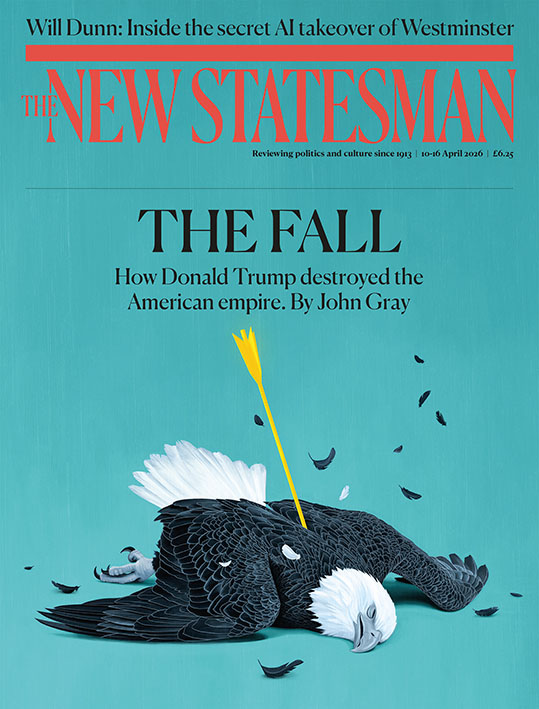
In our cover story this week, John Gray expands on this Kissingerian idea to argue that whatever Trump’s intentions, his role might well be to bring about the end of American hegemony. Through his actions in Iran, Trump has not only brought the world close to ruin, but forced it to give up whatever pretences it once had about the benevolence – or otherwise – of American power. It’s hard to believe that Britain’s relationship with the US can ever go back to what it was before the Trump era. Too much has been said; too much has been seen.
It seems that, inevitably, Britain will soon be forced to focus more of its energy on the domestic affairs of this small island and less on its old visions of projecting global influence through our “special relationship”. The implications of such a shift are enormous, from how we manage our future relationship with Europe to how we manage the technological revolution sweeping through our economy. As Will Dunn shows on page 26, British democracy might already be paying a price for our American dependence in ways that few of us are likely to be happy with.
I return to the north-east to finish on a note of optimism. Contrary to Bryson’s lament, not everything grows shittier. On Easter Sunday I found myself in Bishop Auckland, where one corner of the town has been utterly transformed through the funding of the philanthropist Jonathan Ruffer. Where once I knew “Bish” as a teenager as a place to be avoided on a night out, I now take my children there to show them Auckland Palace, the Mining Art Gallery and walled gardens. I am reluctant to let too many people in on the secret, but County Durham is the new North Yorkshire. At least in my book.
[Further reading: The agonising death of liberal atheism]
Content from our partners



Related


This article appears in the 08 Apr 2026 issue of the New Statesman, The Fall
Join the debate
Subscribe here to comment